
AI is already in your tender process. The evidence trail isn't.
Your team is drafting requirements, interrogating bids and attempting comparisons with AI. None of it connects to an approval, an audit trail or an answer you can give when someone asks how the award was reached.
.jpg)
Key findings
A paper on what has to be true before AI belongs in a renewable-energy tender.
Two mandates arrived in procurement, in the following order. Use AI. Then evidence it.
Most teams got the first one. It came from the board, or it came from people who simply got on with it because the tools were there and the work was piling up. Requirements got drafted faster. Bid packs got read properly for once. That was capable people using what was available, and it created real value.
The second mandate is the one nobody has an answer to. When a preferred bidder is challenged, when an investment committee wants to know why this turbine package and not that one, when an auditor asks which parts of the evaluation a person actually did, the answer sits in someone's browser history.
This is not a discipline problem. It is a sequencing problem. Adoption ran ahead of the operating model, which is what adoption does.
What the paper covers
The accountability gap, and why it opens fastest in organisations running several projects at once rather than in the ones moving slowly.
A maturity test for AI use in sourcing, with the vendor bias in it declared and at least one limitation no platform solves.
What governed AI use looks like in practice on a real tender: who authorises what the AI can touch, where the human approval step sits, and what the audit trail has to hold for the decision to survive a challenge.
The questions to put to any vendor, including us.
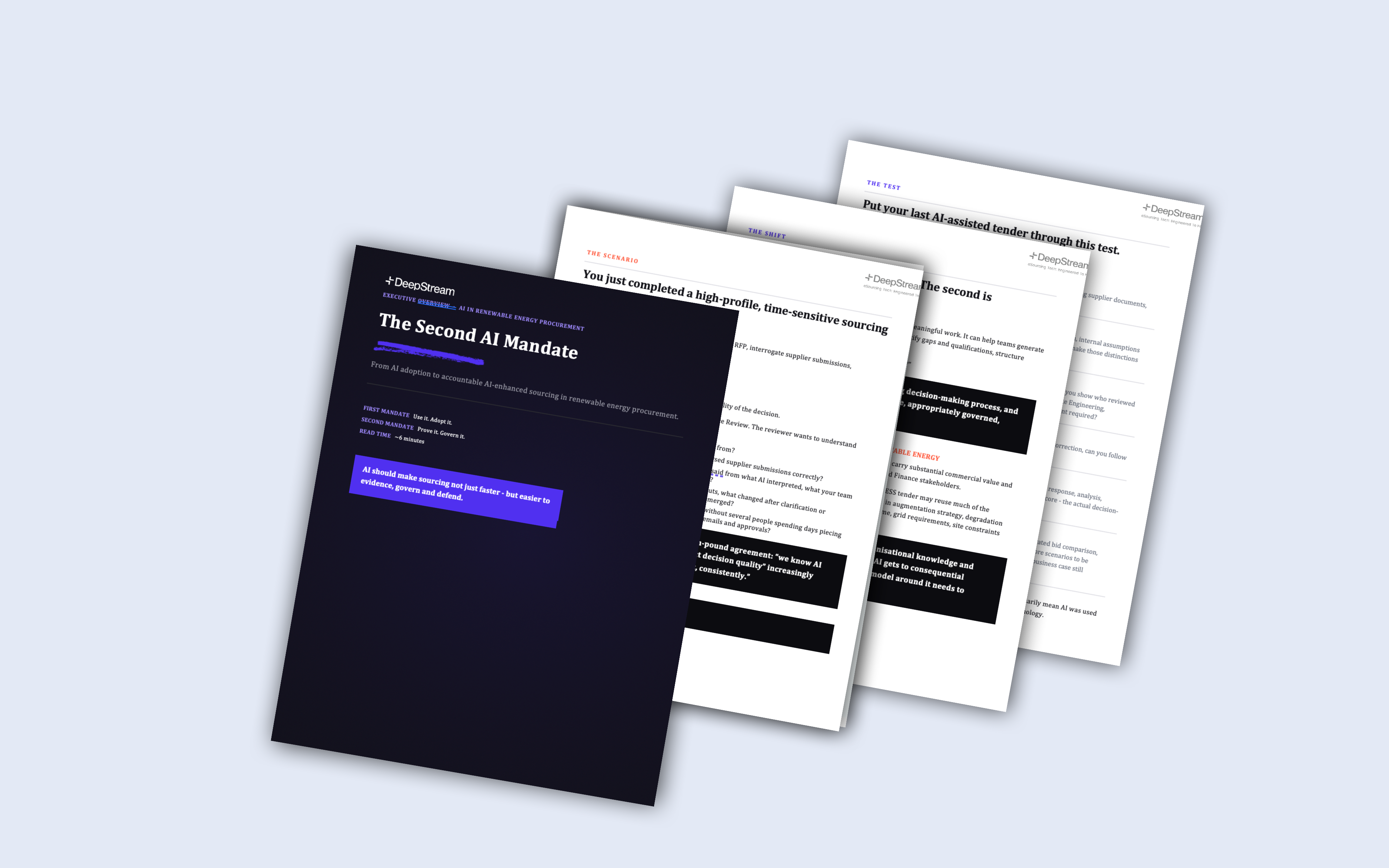
Who this is for
Procurement leaders at multi-project developers, IPPs and asset owners, procuring for new build across parallel projects in development and construction. Wind, solar, BESS, hydrogen, and the balance-of-plant and high-voltage works around them.
It will be less useful if your sourcing is genuinely one-off, if nobody owns the process well enough to change it, or if engineering, project delivery and commercial are not part of the conversation. That last one matters most: the evidence gap opens where they evaluate, not where procurement files. We would rather say all of that now than after you have read forty pages.
Why us on this subject
DeepStream is an AI-enhanced eSourcing platform, purpose-built for, and with, Renewable Energy. The paper sets out our own position in full: which models run the AI functions and who operates them, where processing happens, what is not retained and not used for training, how AI is switched off per user, and where the human approval step sits in the product rather than in a policy document. The paper argues a standard. We are willing to be held to it.
Governance hardwired into every sourcing event. And implementation in weeks: first meaningful value typically within 3-4 weeks, not a lengthy transformation programme.
Spend Matters Customer Favourite, H2 2025. The Hackett Group Customer Value Badge 2026. Representative Vendor in the 2026 Gartner® Market Guide for eSourcing.
Frequently asked questions
About the author
.jpg)
Read the full report
Download the PDFeSourcing Tech: Engineered To Fit
DeepStream delivers best-of-breed AI-enhanced eRFx software with supporting source-to-contract modules. Our tech delivers the essential features that empower procurement teams to mature, step by step, without risking digital overwhelm. We prioritise usability, ensuring our solution is the simplest, cleanest, and most user-friendly in the industry, bolstered by our strategic customer success function.

Procurement software teams want to use.

Want to talk?
Get in touch.
