Run a final pricing round with your shortlisted suppliers, inside the same sourcing event. Move them to a BAFO stage, collect revised prices line by line, and award with every round on the record.
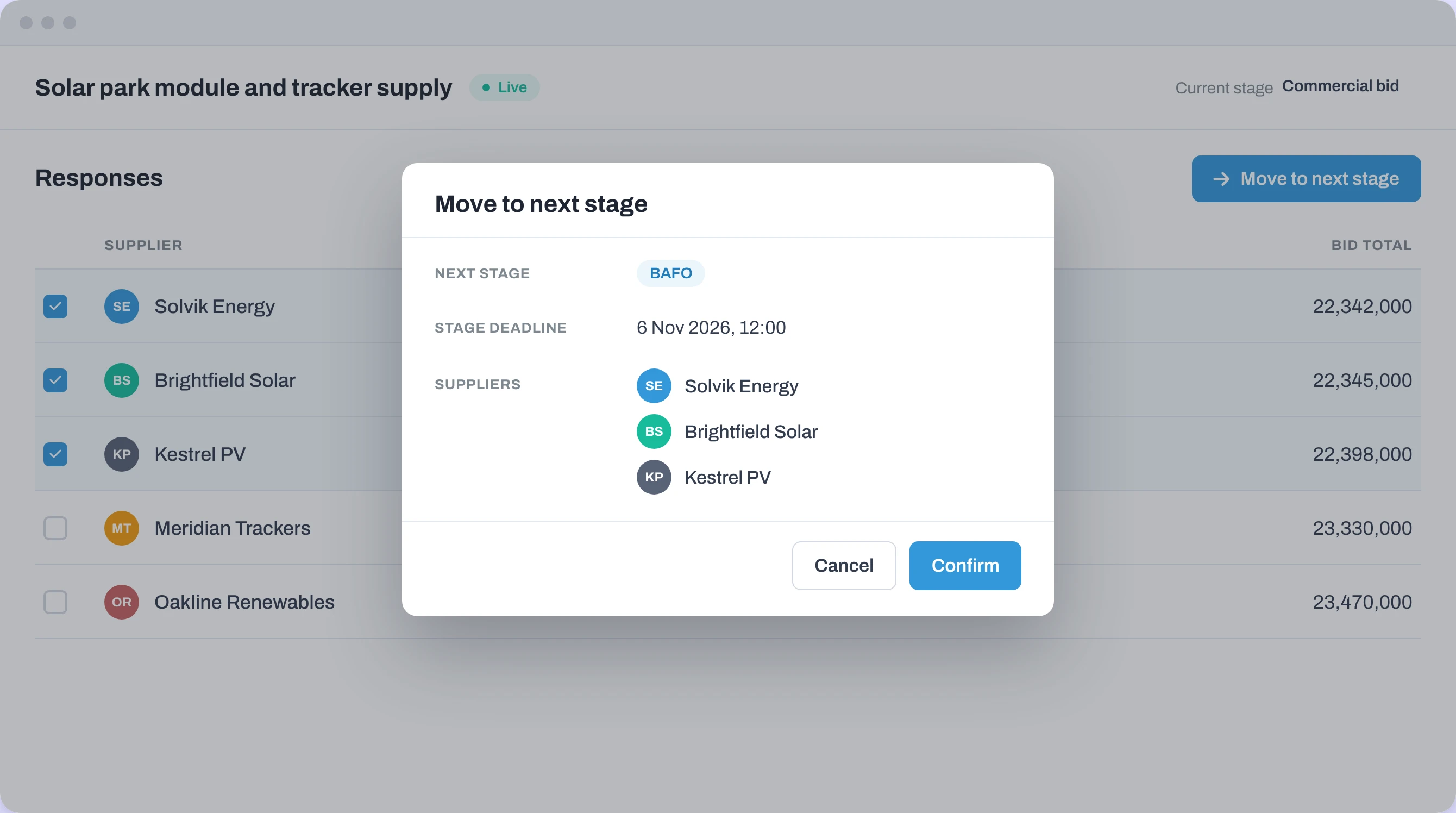
The 81 second walkthrough above shows a BAFO round on a solar park tender: round-one bids compared, three suppliers shortlisted and moved to a final stage, revised prices submitted, first and final prices compared line by line, and the award.
14%
average saving against budget
when buyers run a BAFO round on DeepStream. Results vary by category and by how competitive the first round was.
A BAFO, or best and final offer, is a last round of pricing in a tender. Once the first bids are in and evaluated, the buyer invites a shortlist of suppliers to submit their final offer against the same scope and a fixed deadline, then awards on those final offers.
A BAFO round in five steps, all in one sourcing event
Nothing is re-keyed between rounds, and nothing is lost in an inbox.
Compare round one
Line up the first bids and the evaluation scores. AI bid comparison summarises compliance, pricing and gaps across every supplier.
Shortlist and move
Select the suppliers you want in the final round and move them to a BAFO stage with its own stage deadline. The rest stay where they are.
Re-price
Line items set to a response per stage open again, so suppliers submit a fresh price on every line. Their round-one prices stay on record.
Compare first and final
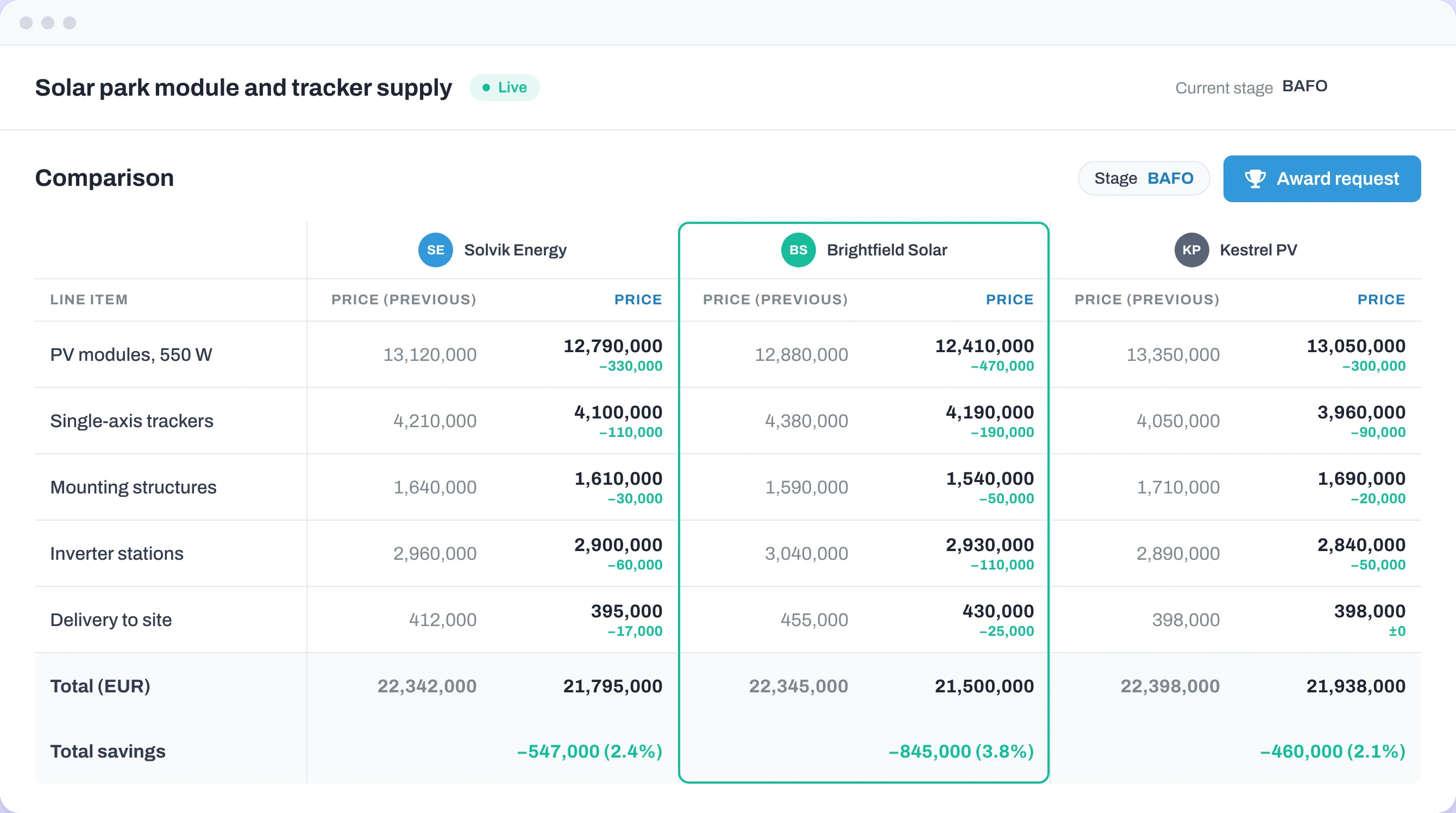
Each supplier's previous price sits next to its final price on every line, with the change and the total saving per supplier.
Award
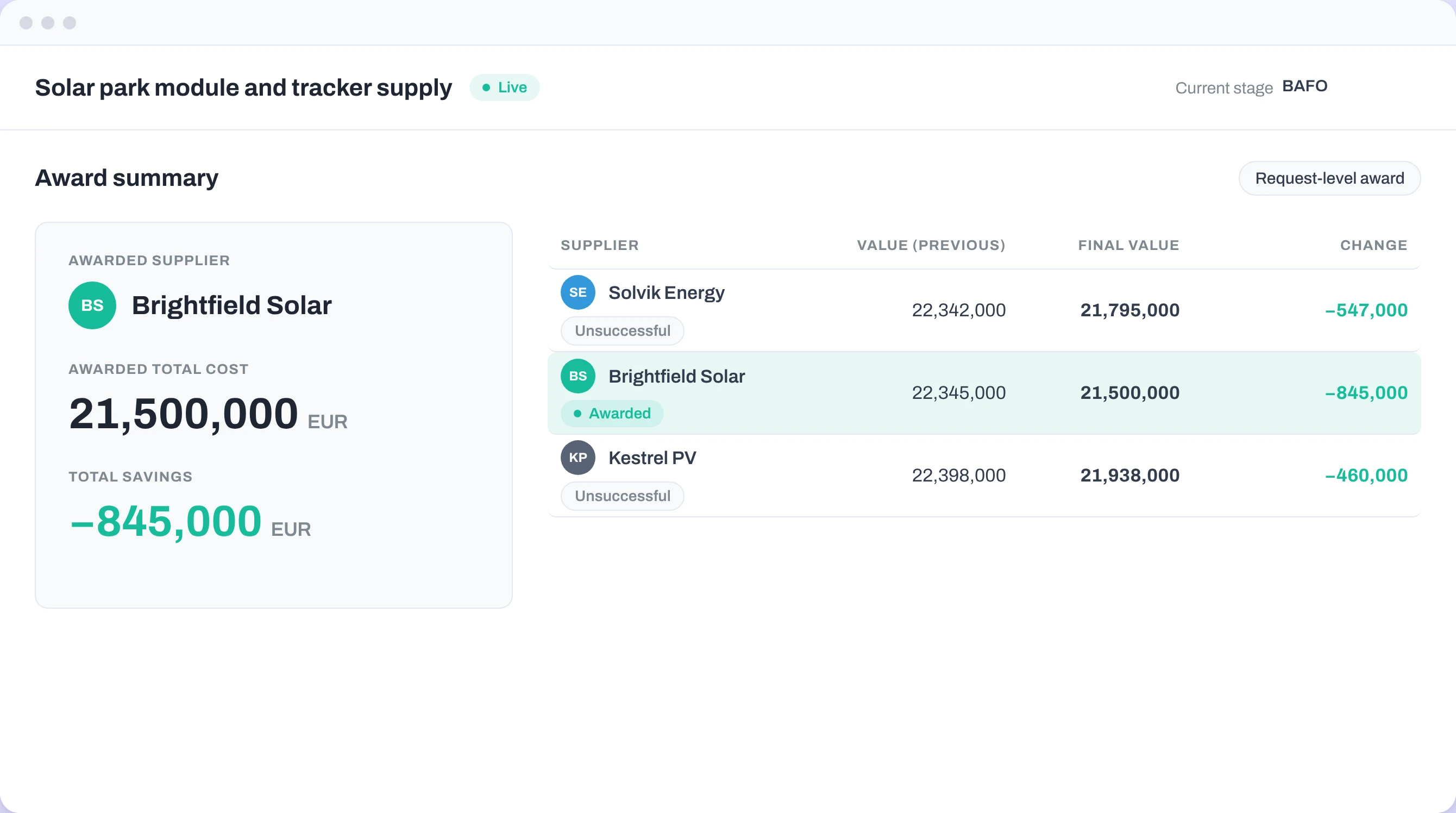
Award on the final offers. The award summary shows the awarded supplier, the final value and the saving, and every round stays in the audit trail.
Step 2: shortlisted suppliers move to the BAFO stage, with its own deadline.Step 4: previous and final prices on every line, with the saving per supplier.
BAFO, eAuction or negotiation: which fits?
All three settle the final price. Which one fits depends on what is still open when round one closes.
BAFO
Reverse eAuction
One-to-one negotiation
Best when
Price and some terms are still open, and several strong bids are close
The specification is fixed and price is the only thing left to settle
One supplier is clearly preferred, or the scope needs reshaping with them
How suppliers respond
One final offer each, against the same line items and the same deadline
Live bids against each other, lowering the price by a minimum decrement until the auction closes
Discussion and revised proposals, usually by meeting and email
Less suited to
Bids that are too far apart to compare, or a single-source buy
Complex packages where quality, scope or terms still differ
Competitive tenders where every supplier must be treated the same way
In DeepStream
A stage in the same sourcing event, with every round on record
Use clarification messages in the event, so the exchange stays on record
Worked example: a solar park supply tender
In the walkthrough above, a buyer runs a BAFO round on a demo project: module and tracker supply for a solar park, priced in euros. Three suppliers were shortlisted from round one and asked for their final offer.
Supplier
Round one (EUR)
Final offer (EUR)
Change
Solvik Energy
22,342,000
21,795,000
547,000 (2.4%)
Brightfield Solar (awarded)
22,345,000
21,500,000
845,000 (3.8%)
Kestrel PV
22,398,000
21,938,000
460,000 (2.1%)
The lowest round-one bid did not win. Brightfield Solar moved furthest in the final round and was awarded at 21,500,000 euros. These are demo figures to show how the comparison works, not a benchmark.
The same rules for every supplier
A final round only holds up if every shortlisted supplier competes on the same basis.
Same line items
Every shortlisted supplier prices the same lines, in the same structure, so final offers compare like for like.
Same stage deadline
The BAFO stage has one deadline for everyone. No supplier gets extra time.
You choose what reopens
Set which fields take a fresh response in the new stage, such as price only, or price with delivery terms. Everything else stays as submitted.
BAFO: common questions
What is a BAFO in procurement?
A BAFO, or best and final offer, is a final pricing round in a tender. After the first bids are evaluated, the buyer invites a shortlist of suppliers to submit their last and best offer against the same scope and deadline, and awards on those final offers. Our guide covers what a BAFO is and how to run one.
When should you ask for a best and final offer?
When the first bids are close, when several shortlisted suppliers could all deliver, or when evaluation has clarified the scope and suppliers should price the final version. It adds less when one bid is clearly ahead or when bids are too far apart to compare.
How many suppliers should go through to a BAFO round?
A shortlist of two to four is common: enough to keep the round competitive, and few enough that every supplier has a realistic chance of winning. In DeepStream you choose exactly which suppliers move to the BAFO stage.
Can suppliers change more than price in a BAFO?
Yes, if you allow it. For each field you choose whether suppliers respond again in the new stage, so you can reopen price only, or price with delivery or payment terms, and keep everything else as submitted.
Is a BAFO round fair to suppliers?
It is when every shortlisted supplier gets the same line items, the same deadline and the same information. In DeepStream the BAFO is a stage with one deadline for everyone, and the audit trail records who was invited and what each supplier submitted.
What is the difference between a BAFO and a reverse auction?
In a BAFO each supplier submits one final offer by a deadline. In a reverse auction suppliers bid live against each other, lowering their price until the auction closes. A BAFO suits packages where terms still differ; an auction suits a fixed specification where price is the only open point. DeepStream runs both, including eAuctions as a stage.
What savings does a BAFO round deliver?
Buyers who run a BAFO round on DeepStream save 14% against budget on average. Results vary by category and by how competitive the first round was.
By clicking “Accept All Cookies”, you agree to the storing of cookies on your device to enhance site navigation, analyze site usage, and assist in our marketing efforts. View our Privacy Policy for more information.